
A0 of Freedom
A0 of Freedom artist group believes that to find new narratives for the value of civil society we need to look in the darkest of places, and engage with people who are still able to use their voice despite the impossible context they operate in. The project, established in 2024, brought together a community of art activists from Central Asia to collaborate on a public exhibition of posters, forming a defiant call for the critical value of activists as agents for civil society.
As many activists in Central Asia say, ‘Silence is very popular here’. Most activists are afraid to speak out. Negative, aggressive narratives against civil society have been used by the governments in the region for decades. So indeed we need new framing for the value of our civic work - and of activist artists ourselves. Posters themselves was a deliberate choice for the project medium, being a popular tool of propaganda - but here reclaimed for positive and inspiring messaging.
The A0 of Freedom project is co-led by Diana Rakhmanova and Daria Cybulska. Diana is an artist, curator, art manager, researcher, activist, journalist, and the public foundation Cultural Center "Kuduk" in Bishkek. Daria is the Director of Programmes and Evaluation at Wikimedia UK, trustee at Global Dialogue, and in 2023/24 was awarded a Churchill Fellowship, investigating Central Asia’s online civil society and its resilience responses to a shrinking civic space.
The project was supported by Elmira Kakabayeva who ran an autoethnography workshop for the participants to craft poster descriptions that resonate with their lived experience as artists and activists, and Caroline Sinders who delivered an online safety session.
Throughout 2025 the cohort met for monthly discussions, reflecting on the state of activism and art in Central Asia, comparing it to trends in the UK and US, and examining the role that art projects can play in sustaining resilience and creativity of the civil society. As artists keen on having an impact in their work, the group reflected on using simple, engaging language to communicate clear desires about a different, more open and inclusive world. This is to help their communities to dream of a seemingly impossible joyful future, and inspire people’s hearts towards action.
Daria
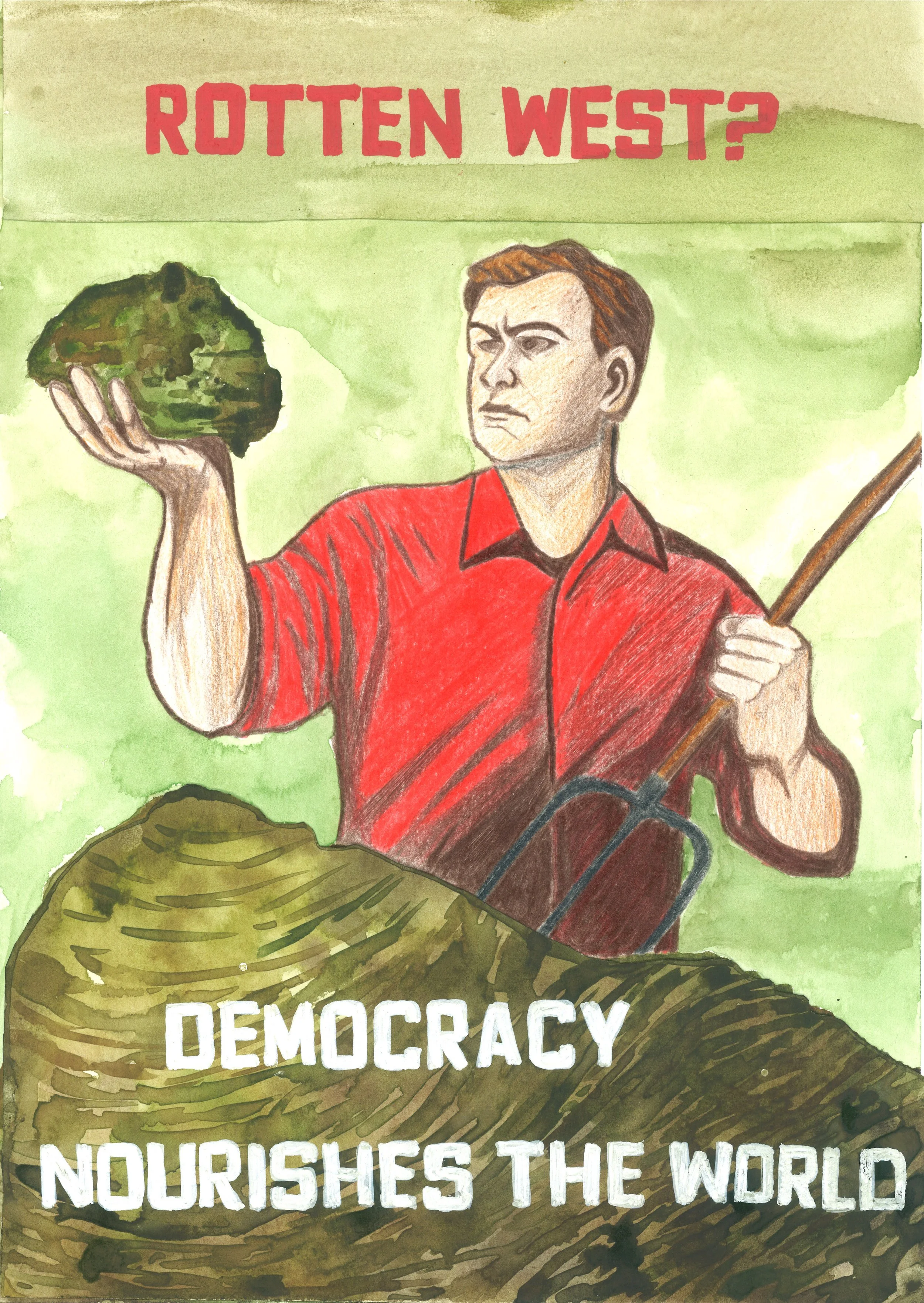
The Rotten West poster uses the visual language of Soviet time propaganda, together with the common slogan of the ‘rotten west’, to speak to the constructive and generative power of civil society and democracy. It subverts the symbolism of something ‘rotten’, reclaims it, and presents it as a fertile space for growth. Democracy is pictured as a living process which can transform its environment for the better - it allows for freedom to draw from and re-mix other’s ideas. It’s organic and therefore responsive to the environment. This is implicitly in contrast to autocratic systems which are stifling and give no space for such growth. The man on the poster appears strong and stern - but there is a softening of that image, since he is engaged in this act of generative composting/gardening.
Several other participants in the A0 project use visual metaphors of nature, roots, connection - the Rotten West poster echoes that organic visual language to stress how something ‘rotten’ can be most alive.
Composting has always been present in my life, starting from early memories of my grandma’s potato peels on a compost pile. Rotting down discarded scraps to create something rich has a very positive connotation for me. This re-mixing and combining things to produce something new holds a meaning for me as a Polish immigrant living in the UK. I internalised the view that the ‘West’ is far superior than my country, yet I also received the communism-time propaganda about the West's ‘rotten morals’. Trying to move away from a colonial black and white thinking, I’m leaning into composting holding a metaphor of combining and integrating West and East, just like the figure on my poster is stern but engaged in a nourishing activity. It’s possible to have both.
Adel
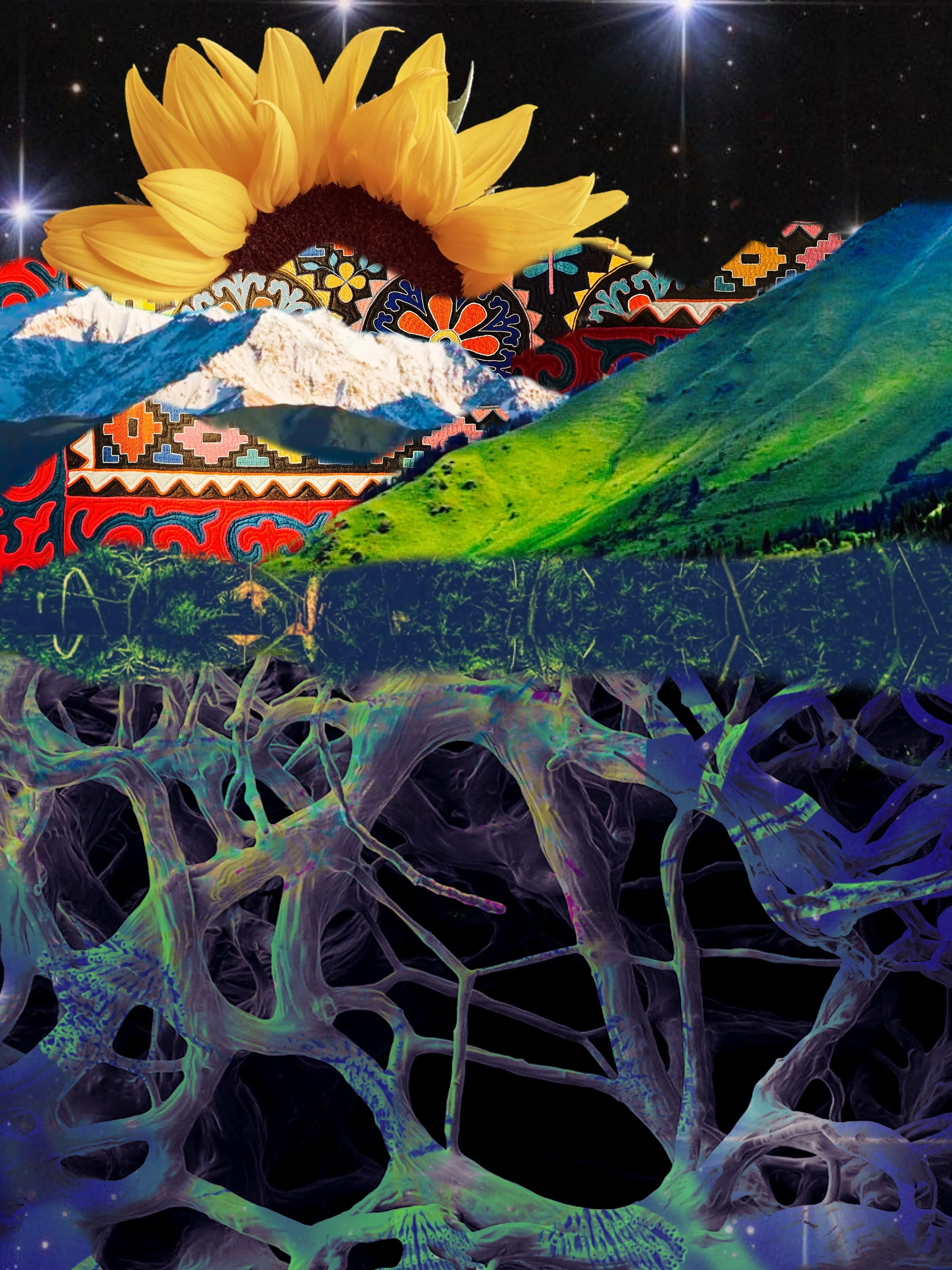
My posters are my personal embrace of activism, how I've dealt with and continue to deal with frustration in activism. My existential journey and awareness of myself as part of a larger ecosystem, part of an activist community. I still conduct my micro-practices, and now I feel more connected to activists than ever. Therefore, these two works are interconnected and complement each other. The first depicts a starry sky with a field of sunflowers; the second depicts a sunflower shaped like the sun and the ubiquitous underground inhabitants—mycelium. The works also feature mountains, which for me always symbolize freedom, the elements, and grandeur. I assembled some of the mountains from tush-kiyiz, traditional Central Asian rugs, which for me signifies an understanding of my roots and decoloniality. But I would like to highlight three main symbols:
Stars. Because activists, like stars, no matter how close or far, shine in the darkness, in this gloomy, endless, and cold sky, but they are always there and they see each other.
Sunflowers. Sunflowers always follow the sun, their heads turned toward the sun's rays and sunlight. There's a wonderful myth that when the sun isn't shining, sunflowers turn their heads toward each other.
Mycelium. Mycelium, or fungal spores, cover the entire globe. Most people are unaware of their significance and importance. But it is thanks to them that plant species diversity exists. Mycelium is the basis of the cycle of life in nature; they are capable of restoring entire ecosystems. And mycelium is also a symbol of the collective unconscious, a kind of "planetary neural network."
Through these reflections on the interconnectedness of everything and everyone. No matter how difficult and unbearable it can be for activists in various fields, I've come to the conclusion: if you're involved in activism, your soul needs it; you're part of something bigger and you're not alone. It's wonderful that in this endless, organized chaos, you choose humanity, love for nature and animals, seek justice, and help those who lack it. These collages are a small reminder, first and foremost for myself. But I'd also like activists who look at these collages to know that sunflowers always reach for the sun, and if you see these collages, then you are the sun.
Ada
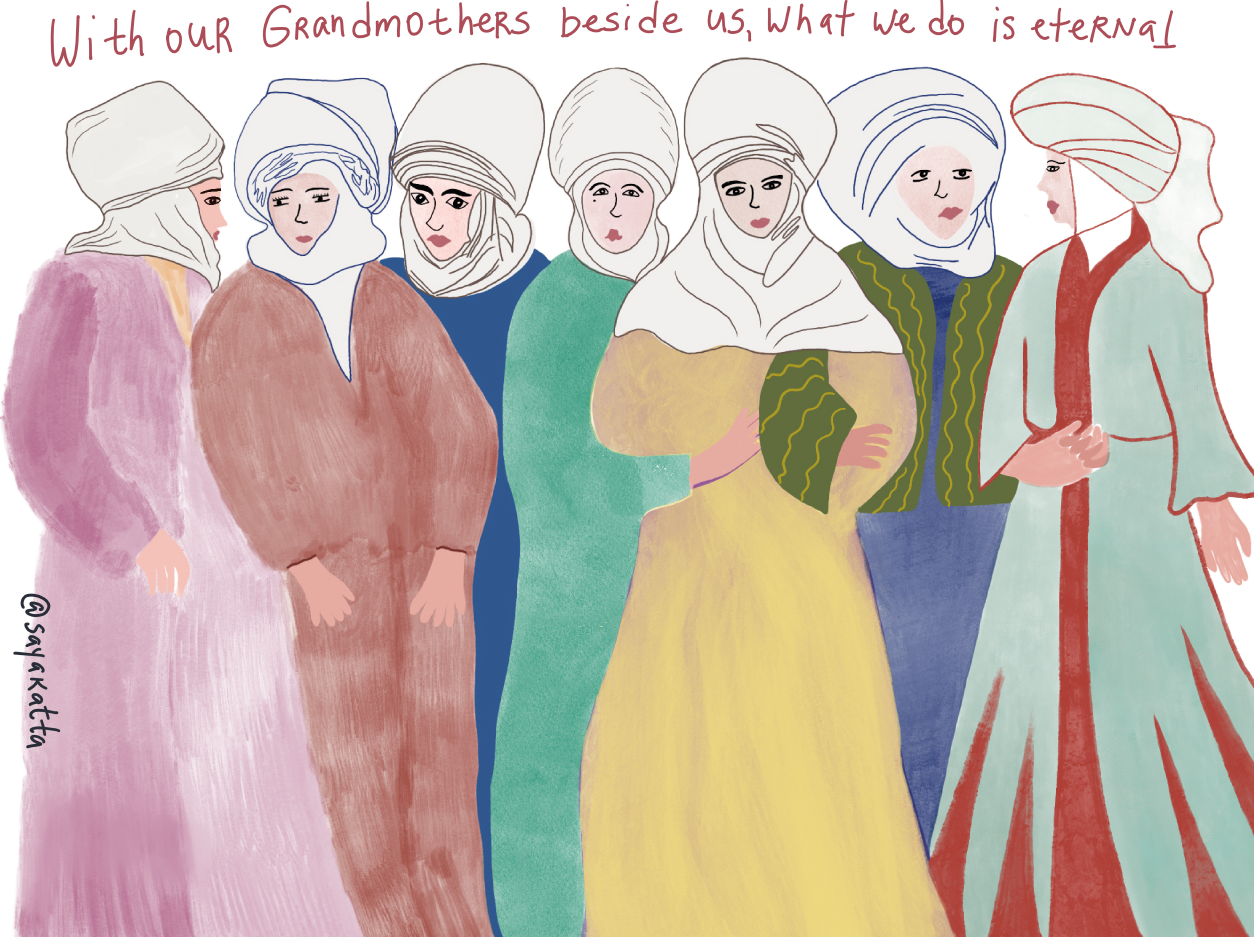
Even in a world that feels sealed beneath a heavy metal lid, what we do is never only for ourselves. It is for our present, in honor of our past, and for the future we dare to imagine. I often ask myself: what would my grandmothers have done if they were here, facing this difficult situation? As a woman, I feel I must live life to the fullest—to follow my heart and do what I truly desire. I owe this honesty to all the ancestors who came before me, and I know they are happy to see me live, grow, and flourish.
The poster portrays seven grandmothers standing together, holding each other and engaged in conversation. Each wears a white elechek, a traditional Kyrgyz headdress made from a long piece of fabric wrapped around the head. In Kyrgyz culture, the elechek carries deep symbolic meaning: after a woman’s death, the fabric was used as a burial shroud, while the remaining material was passed on to relatives as a blessing for long life.
The choice to depict grandmothers arises from a silence: the absence of stories and memories about female ancestors. In our culture, seven generations of grandfathers are remembered, but women are rarely given the same space. This work is my way of creating that space—for my grandmothers and all the women before me—thanks to whom I am here.
Amir
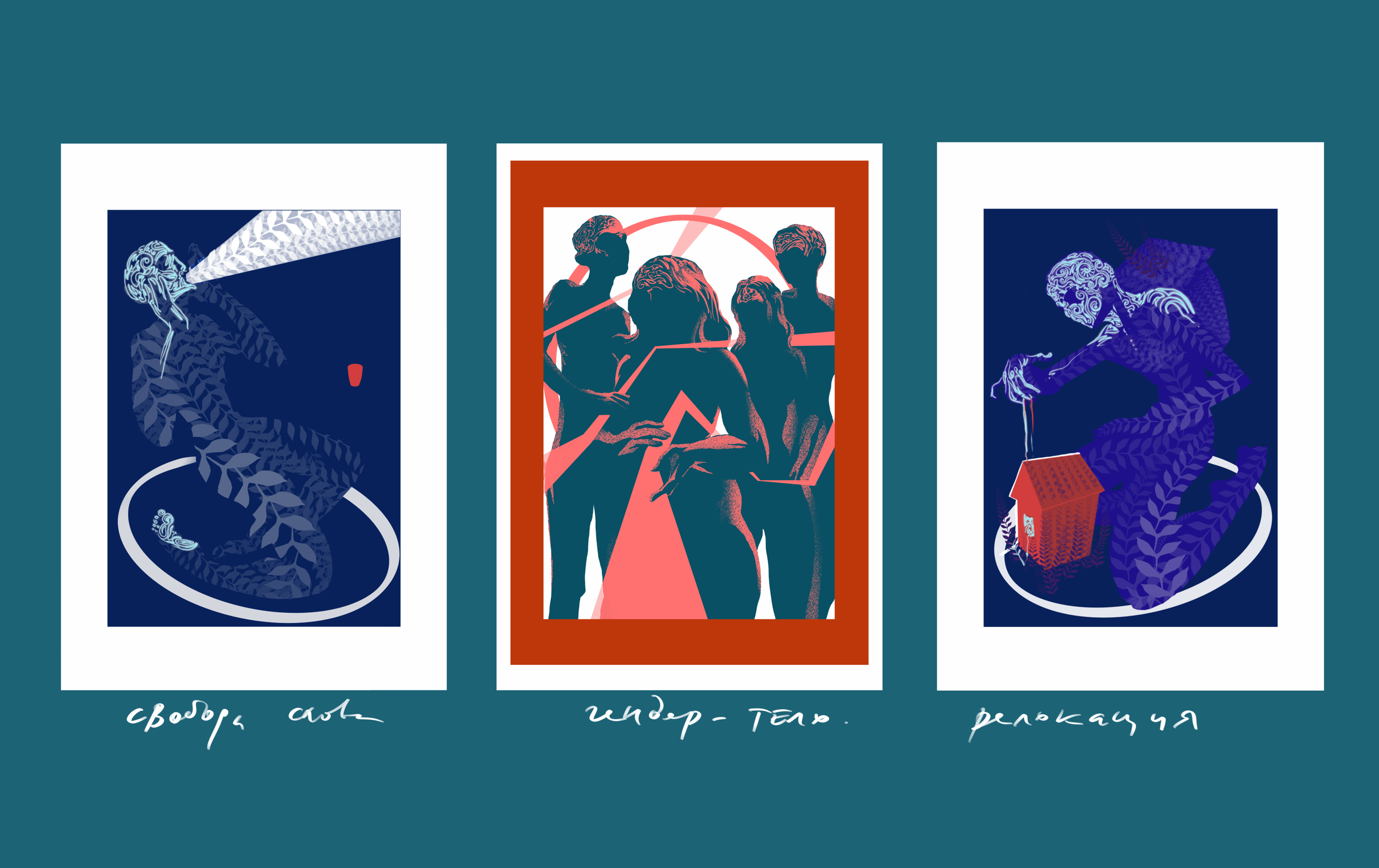
Series: "The Power Within"
Three visual stories about people who don't shout—they germinate.
About those who change the environment around them not by force, but by presence, words, acceptance, and care.
About freedom that doesn't separate, but connects.
About bodies in which peace and usefulness dwell.
About roots that can be retained, even as we move forward.
Freedom of Speech
When a person speaks from the heart, words become seeds.
They don't argue—they germinate.
A word spoken with honesty and warmth becomes a light in which others can find themselves.
Such speech doesn't divide, but awakens.
It gives space to be, to grow, to think.
This is a freedom that doesn't demand, but liberates.
Azalia
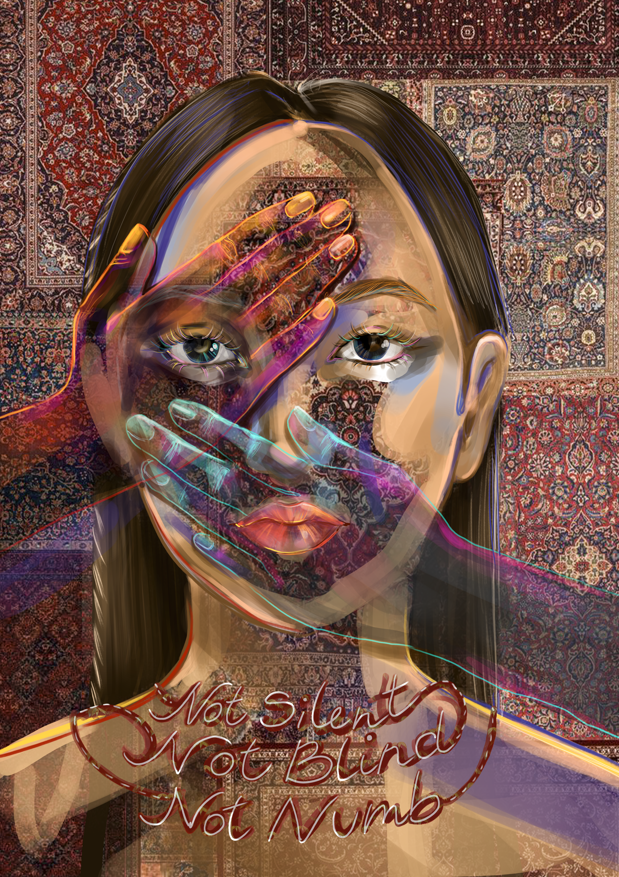
This is a story about those who speak out.
I looked at my sister's hand; there's a scar on it. Was it painful? But it doesn't hurt now. Scars are traces of pain, but that's not the essence of pain, is it?
My heroine is also covered in scars, and from them flowers sprout. These flowers aren't fragility. They are strength that grows precisely where there was pain. They reach for the sun—for a bright goal, for truth.
The Turkic carpet is the heritage of our peoples. The memory of history and culture, woven into the body like fabric. This carpet isn't decoration, but a memory that has absorbed the joys and sufferings of generations. It's like a symbol of the roots that hold us and prevent us from forgetting who we are.
Here art and activism intertwine: art becomes a voice, and a voice becomes a movement. The flowers that break through the wounds are those very ideas and actions that are born from pain but change the world.
This work is about resilience. About how even a land traversed by suffering can blossom. About how personal scars become a collective strength, and history is not a burden, but roots for the future.
Ekaterina
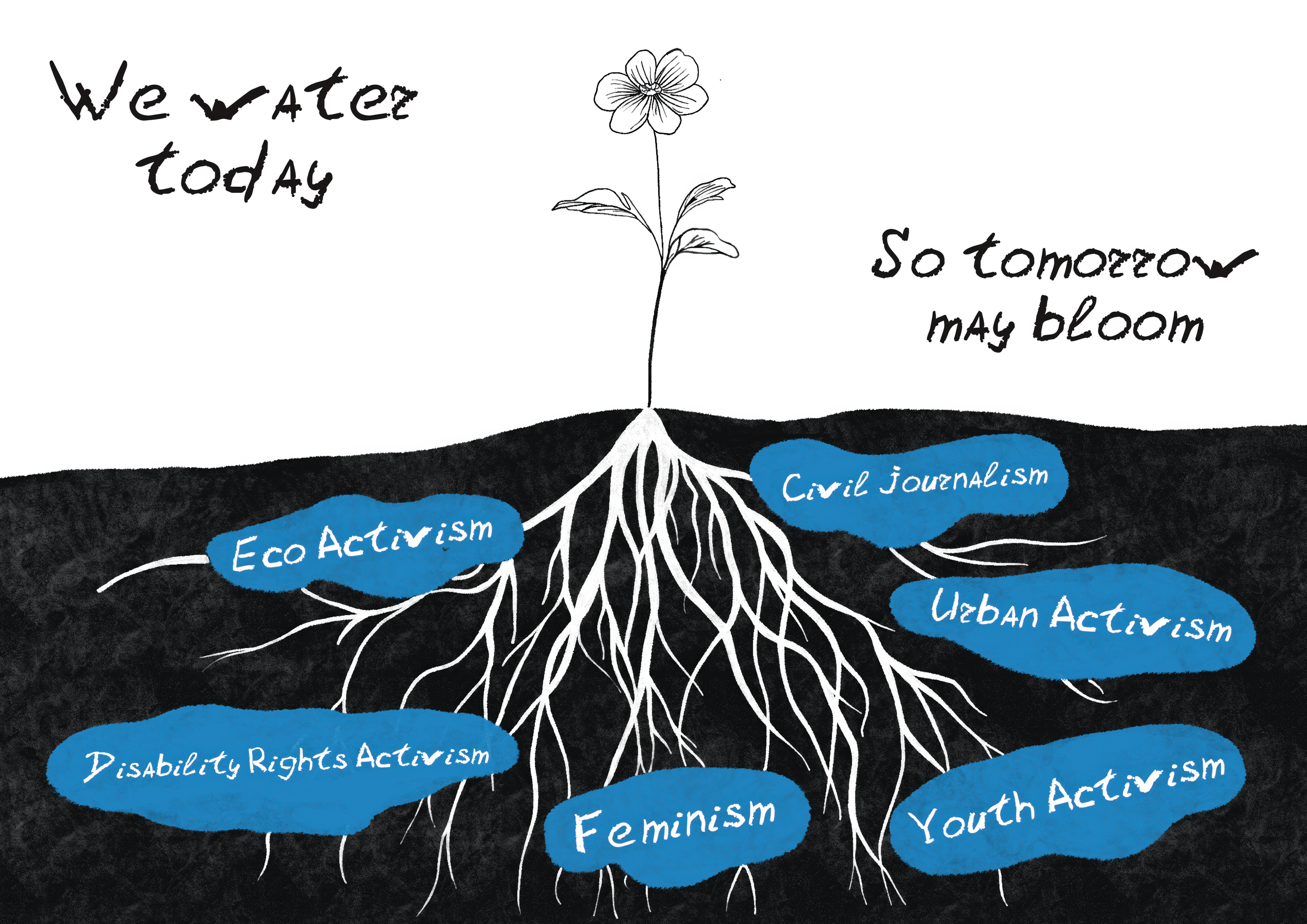
Roots
Strong, dense roots growing underground and getting the water (nourishment) in the various types of social activism. Above the surface – a fragile sprout with a blooming flower.
The flower demonstrates a blossoming day of tomorrow which would not be possible without the tireless efforts of various activists.
Going deeper, the poster is about unseen labour – the tireless, often invisible work that activists do every day. The flower represents hope, growth, and the future we’re striving for — one that cannot exist without the deep and sometimes painful groundwork being laid right now. It's a visual metaphor for patience, persistence, and collective care across movements.
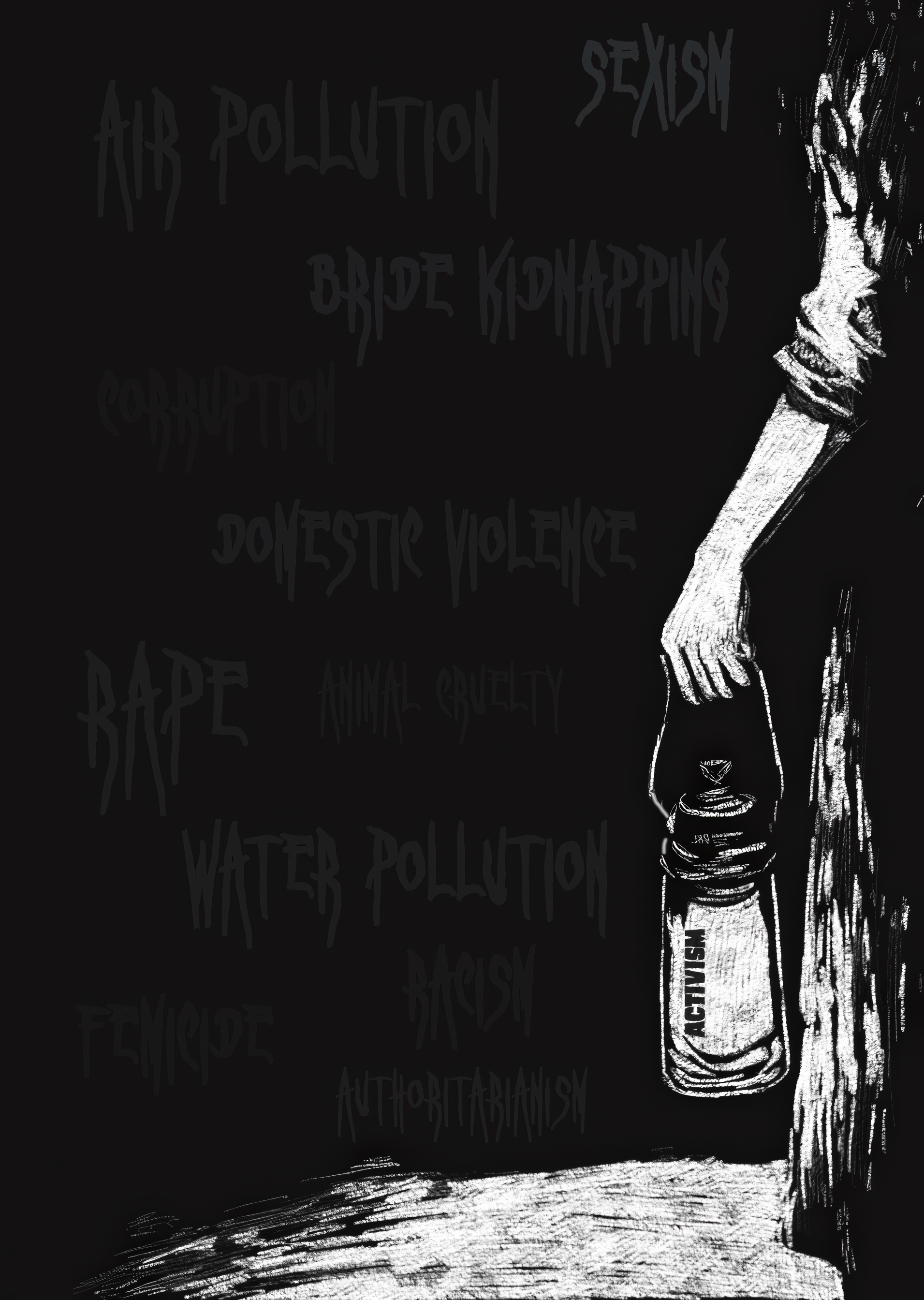
Light
A human hand holds a lantern that glows gently, illuminating the immediate area around it. In the shadows outside the reach of the light, threatening words emerge – bride kidnappings, censorship, corruption, etc. The light doesn’t erase them – but it exposes them.
Activists are not just dreamers – they are torchbearers. This poster frames activism as an act of courage: holding up the light when it’s easier to look away. The darkness represents the negative aspects of today’s Central Asia – things that thrive when hidden. The lantern in the hand is a call to action, saying: “Look. This is real. This is not okay.” It also reminds us that change begins with visibility – and even one light can scatter the dark.